
Archives

Fr. Fabio’s Reflections on Preparatory Document: Youth, Faith and Vocational Discernment – Part 1

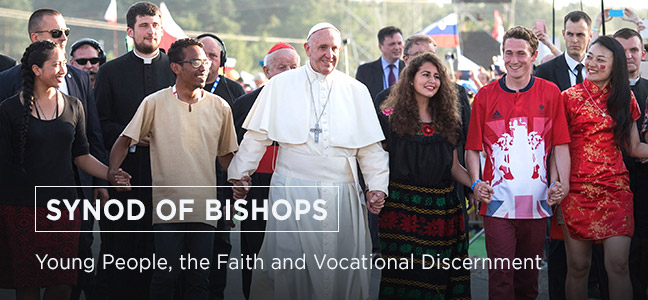
During the conference from ‘Krakow 2 Panama’ held in Rome in April 2017, Fr Fabio Attard SDB was asked to share his thoughts on the third part of the Preparatory Document For The 15th Ordinary General Assembly of the Synod of Bishops “Youth, Faith and Vocational Discernment”. We seriously encourage those involved in youth ministry to read his sharing as it is full of insight. The article will be split into 4 parts and we will upload two parts a week. For those who have not yet had the chance to read the preparatory document please click the following links: MalteseEnglish

PRESENTATION OF PART III OF THE PREPARATORY DOCUMENT
FOR THE 15th ORDINARY GENERAL ASSEMBLY OF THE SYNOD OF BISHOPS
“YOUTH, FAITH AND VOCATIONAL DISCERNMENT”

Part III of the Preparatory Document (PD), Pastoral Activity, could be an easy victim of a purely operational interpretation of the ongoing process towards the Synod Young People, the Faith and Vocation Discernment. Such a summary conclusion is not complete; it is just superficial. Seen in its entirety, Part III of the PD presupposes and builds on the first two parts. Being convinced that pastoral action cannot be thought of as if it were a thing to do, we ask ourselves how can this part help us strengthen the pastoral work as an answer within the overall pastoral journey?

Part III lays open before us several specific challenges that must be read and discussed in the light of the broader journey of the Church. I offer some thoughts around 4 points that help us capture well this Part III and take advantage of the proposals it contains. I propose that we read Part III in the light of 4 perspectives that correspond to sub-titles it contains.

1. Empathy
The first point carries the theme; ‘Walking with Young People’. It is crucial to see the subject in light of the EG (Evangelii Gaudium). The three verbs used – going out, seeing, calling – are the synthesis of EG. And it is precisely in the light of the EG that the journey of youth ministry should be thought and lived.
And here we have a first challenge: the urgent need for us to keep EG as our compass. The importance of studying it well so that it remains a light that guides our pastoral steps: “going beyond a preconceived framework, encountering young people where they are, adapting to their times and pace of life and taking them seriously” is a result of pastoral empathy choice.
Pastoral empathy that shows up in the “willingness to spend time with them, to listen to the story of their lives and to be attentive to their joys, hopes, sadness and anxieties; all in an effort to share them. This leads to the enculturation of the Gospel and for the Gospel to enter every culture, even among young people.”

Going out, seeing, and calling as a pastoral attitude that becomes both a method and a journey. A life’s choice that is the result of the courage to get out of outdated and rigid patterns, the usual “we have always done so.” A choice that joyfully realizes the aspirations and hopes of the young, but also a choice that allows one to be challenged by the suffering and disappointments that they, the young people are paying too high a price.

Only when we prophetically go out and with humility we encounter the story of our young people, then we can be credible. Our words, our proposals have already been listened to and evaluated by young people before they are even spoken or heard. They are experts in judging whether our presence among them is the result of real empathy or just a barren and dry physical one. Walking with the young is beautiful but also demanding. They ask us to accompany them to the truth, but with charity. Our journey with young people is the expression of the journeying Church, the bride of Christ. It is like Christ that we as a Church journey with the young.

These two points, patient and empathic listening, and the journey of the Church, are well summarized in the EG:
As adults, we find it hard to listen patiently to them, to appreciate their concerns and demands, and to speak to them in a language they can understand. For the same reason, our efforts in the field of education do not produce the results expected. The rise and growth of associations and movements mostly made up of young people can be seen as the work of the Holy Spirit, who blazes new trails to meet their expectations and their search for a deep spirituality and a more real sense of belonging. There remains a need, however, to ensure that these associations actively participate in the Church’s overall pastoral efforts (EG n.105).


Fr Fabio Attard SDB

10 Steps to an Authentic Christian Life

I wonder if you have ever come across someone who speaks of nothing but Jesus – in an apocalyptic tone. It seems that the end of the world is so close, that nothing seems to matter much other than Jesus and the afterlife. Not only, but Jesus is spoken of as one who is easily offended by the things we do, and that he awaits for our becoming better, on our own, or else we will be doomed for eternity. Have you ever reflected on such an approach? Do you find this apocalyptic approach to faith attractive? To tell you the truth, to me it isn’t. Don’t misunderstand me. I consider faith in Jesus Christ as central to my life, and to the life of any Christian believer. And that faith should affect life in its entirety.

But if not constant talk on Jesus, what kind of life can be considered a true Christian life? I would like to share with you these 10 steps (in no particular order) which I have learnt along the way; steps which have helped me greatly in both growing closer to God, and to his people.

Step 1: We are One

Every time I look at someone, all I see is a human figure. I do not see a spirit, but a physical body. Yes, we do have a body, and, it being created is a holy thing in and of itself, if we consider God’s creation as divine doing. In other words, we cannot bypass our physical reality. Many a time, throughout history, Christians looked down upon their bodies, founding their argument on St Paul. In Galatians 5, 13-18 the Apostle speaks how the flesh (sarx) works against the spirit (soma). This is a misreading of Paul, as he is not talking of the human body here but of the distorted cravings humanity experiences such as pride or impure sexual desires. Consequently, many Christians do not consider the body essential to one’s life of faith, since for them, faith is something of the soul and not of the body. However, we are one; body, mind and spirit. And we have the responsibility to care for all the three accordingly. Thus, we need to respect and care for our bodies. A good healthy diet together with some form of exercise do not only keep us fit but they also help in the overall care of our mind and soul. The mind too needs special care and attention. Just think of a thought which cannot leave your mind, and how this affects you day after day. It is thus important to keep our emotions under control, by venting them out with significant others, both friends and more competent persons. It is important to note is that Jesus did not come to save souls, but human beings in their totality!

Step 2: Yes, We have a Soul Too

Only with an awareness of our physical and mental reality can we take care of the soul in a fuller way. If not, we run the risk of constantly flying into faith; and flight into faith is not really a good faith (faith is not a magical problem-solver but a journey, a way of life). And so, each person is invited to pray, to build and hold a relationship with God through Christ. This is what prayer is; and all that we do – such as Bible reading, attending mass, adoration, worship and saying the rosary – falls under this relationship with God. Together with our talking to God, we are also invited to examine our conscience. In other words, we are invited to reflect upon our words, deeds and actions and see if these reflect our being Christians. (Prayer is obviously more important than physical exercise, but what I want to present here is Christian life as a whole.)

Step 3: Oh, We have a Character Too!

We all enjoy the company of a person whose character we consider as nice , pleasant, cheerful and well-balanced. And one of the fundamental missions of a Christian is that of being a witness, a good advertisement for Christ and his Church. Now what makes a good ad, if not its appeal to what it presents? Similarly, the Christian is expected to be a beautiful balanced mixture of body-mind-soul. Then, we can say that the whole package of body, mind and soul, comes forward into what we refer to as character. A beautiful character is primarily achieved through self-acceptance, a balanced lifestyle, a sense of gratitude and an acceptance of life as-it-comes, living in the present moment as much as possible and an overall contentment.

Step 4: Expanding the Mind

“Read if you want to get good grades at school.” Don’t we all know that phrase all too well?! It is because those responsible for our education know how important reading is for our path of life. So, for the Christian, it is also important to enrich oneself with a variety of reading, that is, from novels to history books, from books about science to books about the faith, from self-help literature to biographies and lives of saints. Rather than being gullible, the committed believer is invited to be challenged, even by the difficult arguments and to keep on searching for answers (not the quick ones … those are normally immature answers).

Step 5: The Christian is a Giver

But what will a balanced life serve for? Becoming a better person is fundamental but if we stop at that, then we have a problem. The Christian is expected to live a life of love, which results in compassion, kindness, tenderness, understanding, patience, sympathy, forgiveness, hospitality, and service. My actions need to reflect my faith, that which I confess to believe in. It is paramount that we learn how to give and not only to receive. The more we practice a life of giving, the better Christians we become.

Step 6: Together

As just noted, the Christian lives within a larger reality, journeying towards God along with the rest of the world. In other words, how are we to love God, if not by loving other people? And how are we to know of God’s love if we do not know of other people’s love for us? The Christian lives in a community, wherein one shares one’s faith and finds one’s sense of belonging. This is expressed through a living participation within the church. For us Catholics, our life of faith is expressed along with others in the Sunday Eucharist, partaking in the sacraments, sharing of our faith and our lives as one big family. Along with this, Christians are expected to serve others together, as one church.


Step 7: Discernment

Life is full of choices. We are constantly being faced with small and big decisions, nd it is expected of us to always choose the better option. Whether it is merely going to school by bus or cycling it, to more important decisions such as the friends I choose to be with, what subjects I choose at school, to other issues such as how to vote and how I should speak to parents or teachers. And throughout life, such questions will never cease to arise. Now, since faith does not only affect one’s life while in church or during worship, but affects all of one’s life, the Christian is invited to put on the “specs” of faith before the many decisions one is challenged with. Here we need discernment. What this means is that Christians are invited to try and understand what it is that God wants. This of course is not needed in trivial decisions, such as how do I go to school, but on the more important decisions we do need to discern. First, I need to weigh both ends of the spectrum and see the pros and cons in each possibility and then I go to God and ask for enlightenment on which is the preferred option, that will help me on my journey of growth and service. Enlightenment is sought through personal prayer with scriptures, readings in the liturgy and homilies, good books which deal with the related decision and spiritual direction.

Step 8: Personal Calling

Then of course, there is the most important discernment of one’s life: what has God created me for? What is it that he wants from me? Unfortunately, such discernment is usually related to clerical and religious vocations. It is more often heard that someone is discerning the life of a friar, a nun or a priest, but few seem to be discerning the married life, and whether one’s partner is the right one indeed. Vocational discernment (by vocational meaning all forms of life, including marriage or single life) becomes the pinnacle of the Christian, because belief in a God who has plans for me, will result in me wanting to know what these plans are.

Step 9: Ongoing Conversion

            If each person is on a journey to become better at something, be it a better person, a better musician, a better lawyer, a better dancer, a better carpenter, a better painter, and so on, one needs to accept constant challenges and face them head on, in order to become better at one’s area. The same can be said of the Christian. For one to become a better Christian, a holy person, one needs to continually endeavour to a life of conversion; that is, constantly choosing what is good over sin. Through prayer, discernment and examination of conscience, we constantly face barriers which we can either choose to stop at or else to overcome them and move forward along the journey.

Step 10: Abandonment, Trust and Hope

Ultimately, it boils down to abandonment in God; but as I have already noted in the beginning, abandonment does not mean staying only on the receiving end and doing nothing. I    have invited you to do a lot of things, but by this I do not mean that we are going to save ourselves by our doing. We do because we are not babies anymore and our faith needs to mature as we mature into the stages of life. During our teenage years, we are invited to live a teenage faith but the more we grow into adulthood, the more our faith is to mature.

Yet the underlying attitude in whatever we do needs to be that of abandonment, of trust and hope in him who owns everything, who rules everything and who loves us beyond compare, so much so, that he is worthy to be trusted completely with our lives. It is important to note that the Christian understanding of hope is not that everything turns out as I want it, but that whatever turns out, God will use it for my progress. Faith is a journey of wholeness; in other words, becoming holy means becoming whole. And from my experience, this is what following Jesus is all about.

Br Jethro Bajada OFM Cap